

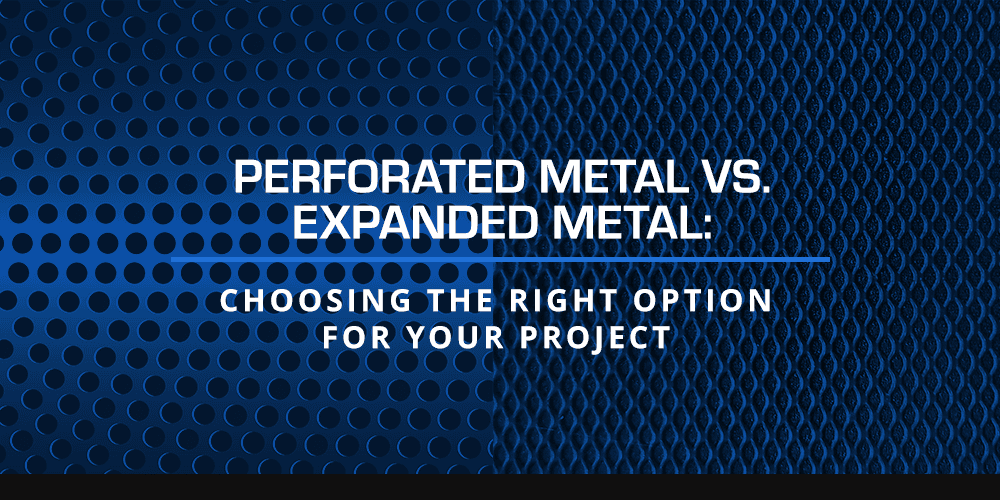
Perforated Metal vs. Expanded Metal: Which Is Right for You?
Your choice of metal product determines project performance, timeline and long-term durability. Making the right industrial purchases requires a sound understanding of each option’s strengths and limitations. Comparing perforated metal versus expanded metal helps you choose the best option for your project.
This guide provides a clear, practical comparison between these options. We’ll break down the benefits and potential limitations of both to ensure your selection aligns with your project goals and performance standards.
The Right Metal for Your Project
Industrial buyers face several challenges when choosing between perforated and expanded metal. The decision means balancing multiple factors, including:
- Strength and durability: Selecting a material that can withstand the demands of a specific application.
- Product quality: Choosing a material that meets project and customer requirements — including fit, finish and dimensions — and performs under the desired conditions.
- Functionality: Ensuring the metal delivers on its intended purpose, whether it’s ventilation, screening, walkway safety or equipment protection.
- Maintainability: Considering how the material will withstand its particular environmental factors and maintain performance over time.
Both perforated metal and expanded metal are versatile, quality options with distinct advantages. The key is understanding which material aligns with your project’s specific requirements.
What Is Perforated Metal?
It’s a sheet metal that has been mechanically punched or stamped to create a pattern of holes. Often used as an industrial screen material, perforated metal offers precise control over hole configuration. For this reason, it’s often well-suited to applications that require controlled airflow, filtration or specific visual patterns.
How It’s Made
The manufacturing process punches or stamps holes into a solid sheet of metal using specialized dies and presses. Modern perforation equipment creates a wide variety of hole patterns, shapes and sizes with tight tolerances. Round, square, slotted and decorative patterns can all be produced to match project requirements.
Project decision-makers can typically choose from an extensive range of perforated sheet metal configurations. These can come in multiple materials, gauges and hole configurations.
Characteristics of Perforated Metal
Perforated metal features a mostly smooth, uniform surface with consistent hole patterns throughout the sheet. The material maintains the base metal’s original thickness around each perforation.
This process typically creates a flat profile, although in some cases, raised bits of metal may be present. The profile can also vary from one side to the next since the metal can only be punched from one side.
Perforated metal applications include projects where whole patterns control material flow or provide visibility while maintaining protection:
- Filtration systems
- Ventilation panels
- Screening operations
- Acoustic enclosures
- Protective covers
Perforated metal is effective for sound absorption, light or air control and filtration in industrial processes. It’s also shown to reduce environmental noise, which is important for projects with sustainability requirements or noise control specifications.
What Is Expanded Metal?
Expanded metal is a versatile mesh that’s typically made from steel, aluminum, copper or other alloys. It’s considered a lightweight but strong product that generates no waste in manufacturing. Common uses include walkways, guards and security applications.
How It’s Made
The manufacturing process simultaneously slits and stretches a single sheet of metal in one continuous operation. Through a process of slitting and stretching, interconnected strands form a mesh-like structure with diamond-shaped openings.
This results in a high strength-to-weight ratio because the metal strands remain connected throughout the sheet. The continuous nature of expanded metal products contributes to their structural integrity and load-bearing capacity.
Characteristics of Expanded Metal
Expanded metal features raised strands that create a slip-resistant surface. The material’s structural integrity comes from its continuous strand pattern, which effectively distributes loads across the sheet. It offers durability and strength, making it suitable for demanding applications.
There are two primary forms of expanded metal:
- Standard expanded metal: A raised, textured surface with three-dimensional diamond openings that provides slip resistance for walkways and platforms.
- Flattened expanded metal: Metal passed through leveling rollers to create a smooth, flat profile with reduced thickness for easier secondary fabrication.
The choice between standard and flattened expanded metal uses depends on whether your application prioritizes slip resistance or a smooth surface.
Head-To-Head Comparisons
Comparing direct perforated metal to expanded metal helps industrial buyers match the right product to their application requirements.
Strength and Structural Integrity
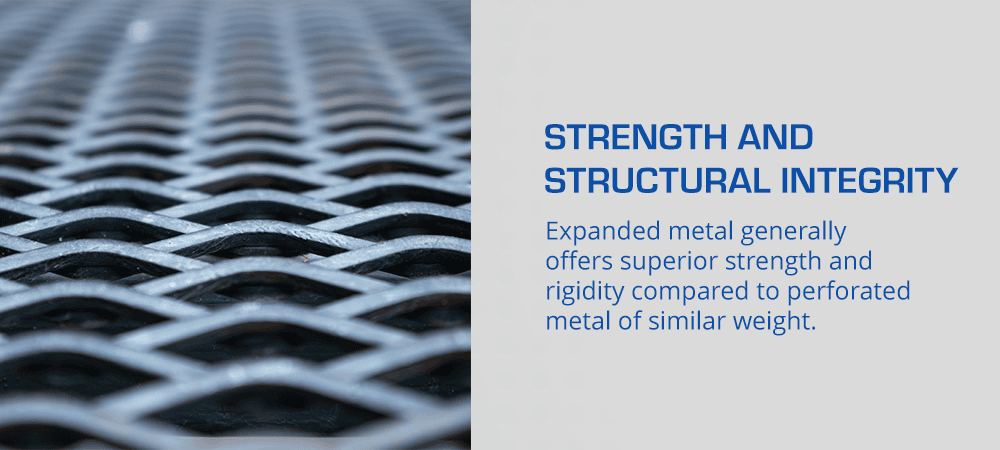
Expanded metal generally offers superior strength and rigidity compared to perforated metal of similar weight. The slits and stretching increase the effective thickness, so it acts like a thicker piece of material with less weight. The structural performance of expanded metal makes it ideal for applications where load-bearing capacity is critical.
Perforated metal’s strength depends on the hole pattern, open area percentage and remaining material between perforations. Higher open area percentages reduce the material’s structural capacity, while tighter hole spacing maintains more strength.
Additionally, you can bend perforated metal in a much stronger, stiffer wave-like pattern. Essentially, this allows you to mimic expanded metal with perforated metal for some applications where strength is more important in one axis than the others.
Weight and Material Efficiency
The no-waste manufacturing process of expanded metal makes it a more material-efficient solution. Since the slitting and stretching process displaces metal rather than removing it, every pound of raw material becomes usable product.
Perforated metal generates scrap during production since material is punched out and removed from the sheet. The amount of scrap corresponds directly to the open area percentage. Material efficiency becomes a consideration when specifying perforated metal for large-scale projects or when working with expensive alloys.
Customization and Design Flexibility
Perforated metal offers wider design flexibility with options for hole shapes, sizes, patterns and arrangements. The variety of perforated metal capabilities allows engineers to fine-tune open area percentages, hole alignment and pattern density to match exact application needs. While architectural metal selection sometimes drives these choices, the same flexibility serves functional requirements in industrial settings.
Expanded metal offers less pattern variation, with diamond-shaped openings in standard configurations based on strand width and opening size.
Choosing the Right Material for Your Industrial Application
Matching material properties to application requirements ensures optimal performance and long-term reliability. The following guidance helps identify which metal is best suited to specific industrial uses.
When to Choose Perforated Metal
Perforated metal applications excel where precise hole patterns, controlled open area and smooth surfaces are critical:
- Filtration and screening operations: Specific hole sizes control particle separation and material flow in processing systems.
- Ventilation systems: Controlled open area percentages manage airflow while maintaining structural panels.
- Acoustic enclosures: Perforated panels reduce noise transmission around equipment or in facility design.
- Protective covers with visibility requirements: Guards and enclosures need specific hole patterns for sight lines.
The smooth surface and precise hole configuration make perforated metal suitable for applications that require dimensional accuracy.
When to Choose Expanded Metal
Applications requiring strength, security, slip resistance and durability benefit from expanded metal’s structural characteristics:
- Walkways and platforms: The raised surface provides slip resistance in industrial facilities and outdoor installations.
- Machine guards: Strong, impact-resistant barriers protect operators while maintaining visibility and ventilation.
- Security fencing and panels: The interconnected strand pattern resists cutting and provides robust perimeter control.
- Equipment enclosures: Protective barriers combine strength with airflow for cooling needs.
Reviewing the various types of expanded metal can help you identify the style and opening size that best match your load requirements.
Why Trust Argus Steel?
The choice between perforated and expanded metal depends on your project’s demands for strength, material efficiency and functionality. Understanding these differences helps you select the right metal mesh types and industrial screen material. Working with an experienced distributor ensures you get the correct specifications to meet your project goals.
Argus Steel Products has been a trusted metal distributor since 1979, offering an extensive inventory of perforated metal, expanded metal and specialized materials. Our team provides the expertise to ensure you get the right material for your application.
Request a Quote From Argus Steel Products
Argus Steel offers fast shipping with no minimum order, keeping your project on schedule. Whether you need stock products or custom solutions, we’re here to help you source the materials that meet your project specifications.
Reach out today to request a quote and discuss your requirements with our team.
Comments are closed