Exit

Author Archives: George Adamanty

  1. Perforated Metal vs. Expanded Metal: Choosing the Right Option for Your Project

    Comments Off on Perforated Metal vs. Expanded Metal: Choosing the Right Option for Your Project


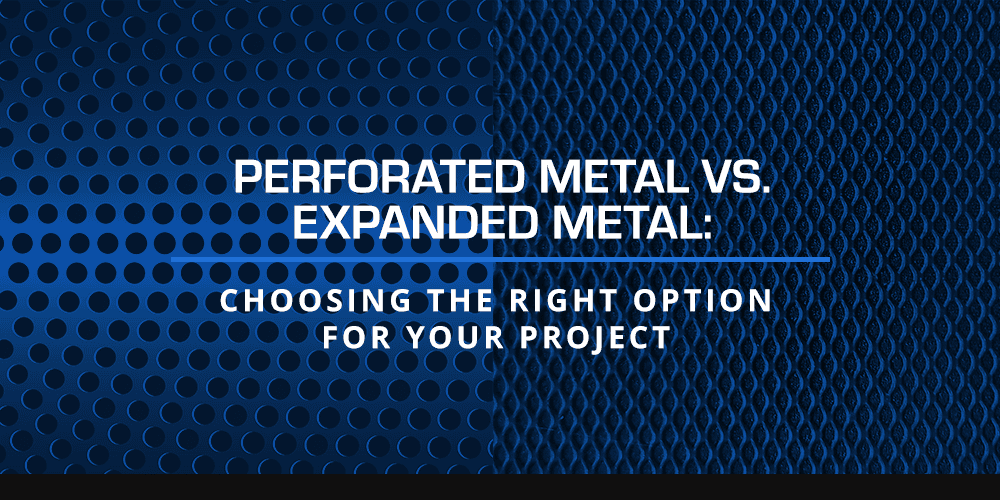
    Your choice of metal product determines project performance, timeline and long-term durability. Making the right industrial purchases requires a sound understanding of each option’s strengths and limitations. Comparing perforated metal versus expanded metal helps you choose the best option for your project.

    This guide provides a clear, practical comparison between these options. We’ll break down the benefits and potential limitations of both to ensure your selection aligns with your project goals and performance standards.

    The Right Metal for Your Project

    Industrial buyers face several challenges when choosing between perforated and expanded metal. The decision means balancing multiple factors, including:

    • Strength and durability: Selecting a material that can withstand the demands of a specific application.
    • Product quality: Choosing a material that meets project and customer requirements — including fit, finish and dimensions — and performs under the desired conditions.
    • Functionality: Ensuring the metal delivers on its intended purpose, whether it’s ventilation, screening, walkway safety or equipment protection.
    • Maintainability: Considering how the material will withstand its particular environmental factors and maintain performance over time.

    Both perforated metal and expanded metal are versatile, quality options with distinct advantages. The key is understanding which material aligns with your project’s specific requirements.

    What Is Perforated Metal?

    It’s a sheet metal that has been mechanically punched or stamped to create a pattern of holes. Often used as an industrial screen material, perforated metal offers precise control over hole configuration. For this reason, it’s often well-suited to applications that require controlled airflow, filtration or specific visual patterns.

    How It’s Made

    The manufacturing process punches or stamps holes into a solid sheet of metal using specialized dies and presses. Modern perforation equipment creates a wide variety of hole patterns, shapes and sizes with tight tolerances. Round, square, slotted and decorative patterns can all be produced to match project requirements.

    Project decision-makers can typically choose from an extensive range of perforated sheet metal configurations. These can come in multiple materials, gauges and hole configurations.

    Characteristics of Perforated Metal

    Perforated metal features a mostly smooth, uniform surface with consistent hole patterns throughout the sheet. The material maintains the base metal’s original thickness around each perforation.

    This process typically creates a flat profile, although in some cases, raised bits of metal may be present. The profile can also vary from one side to the next since the metal can only be punched from one side.

    Perforated metal applications include projects where whole patterns control material flow or provide visibility while maintaining protection:

    • Filtration systems
    • Ventilation panels
    • Screening operations
    • Acoustic enclosures
    • Protective covers

    Perforated metal is effective for sound absorption, light or air control and filtration in industrial processes. It’s also shown to reduce environmental noise, which is important for projects with sustainability requirements or noise control specifications.

    What Is Expanded Metal?

    Expanded metal is a versatile mesh that’s typically made from steel, aluminum, copper or other alloys. It’s considered a lightweight but strong product that generates no waste in manufacturing. Common uses include walkways, guards and security applications.

    How It’s Made

    The manufacturing process simultaneously slits and stretches a single sheet of metal in one continuous operation. Through a process of slitting and stretching, interconnected strands form a mesh-like structure with diamond-shaped openings.

    This results in a high strength-to-weight ratio because the metal strands remain connected throughout the sheet. The continuous nature of expanded metal products contributes to their structural integrity and load-bearing capacity.

    Characteristics of Expanded Metal

    Expanded metal features raised strands that create a slip-resistant surface. The material’s structural integrity comes from its continuous strand pattern, which effectively distributes loads across the sheet. It offers durability and strength, making it suitable for demanding applications.

    There are two primary forms of expanded metal:

    • Standard expanded metal: A raised, textured surface with three-dimensional diamond openings that provides slip resistance for walkways and platforms.
    • Flattened expanded metal: Metal passed through leveling rollers to create a smooth, flat profile with reduced thickness for easier secondary fabrication.

    The choice between standard and flattened expanded metal uses depends on whether your application prioritizes slip resistance or a smooth surface.

    Head-To-Head Comparisons

    Comparing direct perforated metal to expanded metal helps industrial buyers match the right product to their application requirements.

    Strength and Structural Integrity

    Strength and Structural Integrity

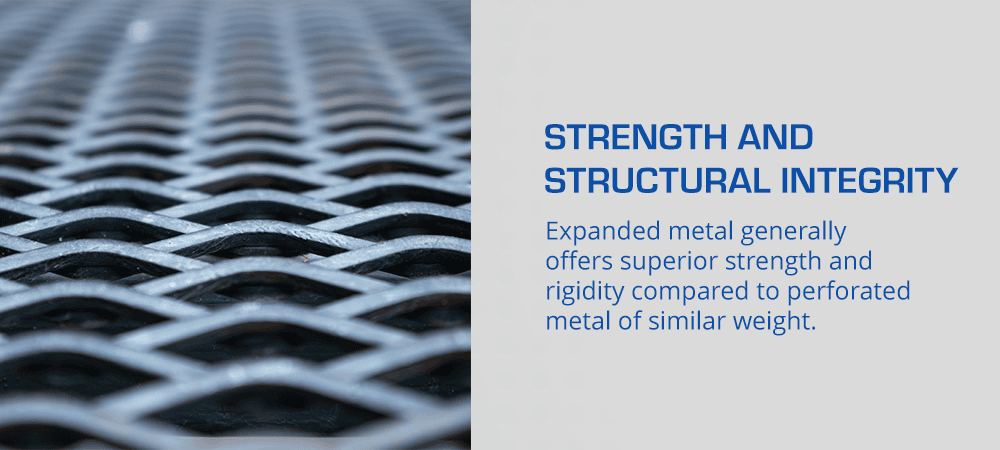
    Expanded metal generally offers superior strength and rigidity compared to perforated metal of similar weight. The slits and stretching increase the effective thickness, so it acts like a thicker piece of material with less weight. The structural performance of expanded metal makes it ideal for applications where load-bearing capacity is critical.

    Perforated metal’s strength depends on the hole pattern, open area percentage and remaining material between perforations. Higher open area percentages reduce the material’s structural capacity, while tighter hole spacing maintains more strength.

    Additionally, you can bend perforated metal in a much stronger, stiffer wave-like pattern. Essentially, this allows you to mimic expanded metal with perforated metal for some applications where strength is more important in one axis than the others.

    Weight and Material Efficiency

    The no-waste manufacturing process of expanded metal makes it a more material-efficient solution. Since the slitting and stretching process displaces metal rather than removing it, every pound of raw material becomes usable product.

    Perforated metal generates scrap during production since material is punched out and removed from the sheet. The amount of scrap corresponds directly to the open area percentage. Material efficiency becomes a consideration when specifying perforated metal for large-scale projects or when working with expensive alloys.

    Customization and Design Flexibility

    Perforated metal offers wider design flexibility with options for hole shapes, sizes, patterns and arrangements. The variety of perforated metal capabilities allows engineers to fine-tune open area percentages, hole alignment and pattern density to match exact application needs. While architectural metal selection sometimes drives these choices, the same flexibility serves functional requirements in industrial settings.

    Expanded metal offers less pattern variation, with diamond-shaped openings in standard configurations based on strand width and opening size.

    Choosing the Right Material for Your Industrial Application

    Matching material properties to application requirements ensures optimal performance and long-term reliability. The following guidance helps identify which metal is best suited to specific industrial uses.

    When to Choose Perforated Metal

    Perforated metal applications excel where precise hole patterns, controlled open area and smooth surfaces are critical:

    • Filtration and screening operations: Specific hole sizes control particle separation and material flow in processing systems.
    • Ventilation systems: Controlled open area percentages manage airflow while maintaining structural panels.
    • Acoustic enclosures: Perforated panels reduce noise transmission around equipment or in facility design.
    • Protective covers with visibility requirements: Guards and enclosures need specific hole patterns for sight lines.

    The smooth surface and precise hole configuration make perforated metal suitable for applications that require dimensional accuracy.

    When to Choose Expanded Metal

    Applications requiring strength, security, slip resistance and durability benefit from expanded metal’s structural characteristics:

    • Walkways and platforms: The raised surface provides slip resistance in industrial facilities and outdoor installations.
    • Machine guards: Strong, impact-resistant barriers protect operators while maintaining visibility and ventilation.
    • Security fencing and panels: The interconnected strand pattern resists cutting and provides robust perimeter control.
    • Equipment enclosures: Protective barriers combine strength with airflow for cooling needs.

    Reviewing the various types of expanded metal can help you identify the style and opening size that best match your load requirements.

    Why Trust Argus Steel?

    The choice between perforated and expanded metal depends on your project’s demands for strength, material efficiency and functionality. Understanding these differences helps you select the right metal mesh types and industrial screen material. Working with an experienced distributor ensures you get the correct specifications to meet your project goals.

    Argus Steel Products has been a trusted metal distributor since 1979, offering an extensive inventory of perforated metal, expanded metal and specialized materials. Our team provides the expertise to ensure you get the right material for your application.

    Request a Quote From Argus Steel Products

    Argus Steel offers fast shipping with no minimum order, keeping your project on schedule. Whether you need stock products or custom solutions, we’re here to help you source the materials that meet your project specifications.

    Reach out today to request a quote and discuss your requirements with our team.

    Request a Quote From Argus Steel Products

  2. Using Expanded Metal Cages for Data Center Security

    Leave a Comment

    Data Cages for Server Room Security

    As e-commerce and other digital operations continue to expand, data center security has become increasingly important.  Data centers are specialized facilities for data processing and remote storage, helping organizations centralize and secure critical information. By housing servers, storage systems and security devices within these centers, businesses can ensure their data remains safe and accessible.

    Cybersecurity helps data centers stay protected. However, there’s another important element to security in these settings — data center cages. These metal cages and partitions keep critical systems and servers organized and safely locked. They are an essential component of server physical security.

    How Are Data Center Cages Used?

    Above all, server cages keep data centers secure. The durable metal and complicated lock systems keep critical data safe and accessible only to the right people, protecting critical computer servers and stored data.

    Here are more applications for data center cages:

    • Cage colocation: Cages serve as organizational tools by providing a secure, private space for clients renting server space in a colocation facility, ensuring their equipment and data are protected within a shared environment. Alternatively, you might want to keep different systems within the same organization distinctly apart. Cage partitions can keep separate servers or systems apart from each other.
    • Control access: You can also control access to servers with metal gates. By using locks or other restrictions on the entrances, only authorized personnel will be able to enter each cage.
    • Prevent damage: Cages also protect your servers and data systems. Most are made with mesh metal wiring, allowing for maximum airflow. As air circulates through, it prevents systems from overheating and keeps them functioning properly.
    • Disaster recovery and backup systems: Cages help protect backup systems and data recovery equipment by isolating them in secure areas, which are separate from the primary data center infrastructure.
    • Regulatory compliance in high-security industries: In finance, healthcare or government, cages safeguard data and hardware in compliance with regulatory requirements for physical security.

    Types of Metal Data Center and Server Room Cages

    There are multiple types of data center cages, each with its own pros and cons. Here are a few examples:

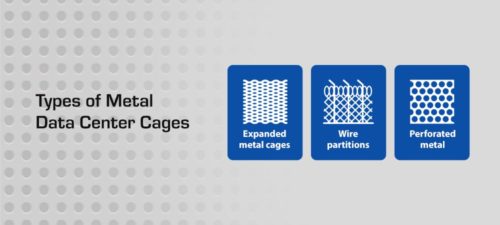
    • Wire cloth cages: This type of data center cage provides security while allowing airflow due to a high percentage of open areas. Hardware generates significant heat, and these openings provide some temperature regulation and ventilation to prevent overheating. Wire cloth comes in welded or woven wire mesh. Welded wire cloth is strong, holds its shape and fits into tight spaces. Woven wire cloth is extremely durable and supports heavy loads.
    • Wire partition: This cage style consists of either welded wire mesh or heavy-duty woven mesh. Wire partitions allow it to be made in various dimensions or sizes, depending on someone’s need. It also has the largest openings available of these types. If you have a wire partition set in a metal frame and tack welded, there is no risk of the barrier coming loose.
    • Expanded metal cages: Expanded metal is durable. Manufacturers make expanded metal sheets by creating multiple slits in them. They then stretch the sheet to create a diamond pattern with the openings. This structure makes expanded metal sturdy, lasting for years on end.

    Regardless of the construction you choose, stainless steel security cages offer exceptional strength, ensuring long-term security and protection. This metal’s corrosion resistance prevents rust and degradation. The rigid structure allows secure enclosures to feature openings that maintain proper airflow for cooling. Various stainless steel products are available, including perforated stainless steel options, bar grating and wire mesh.

    Choosing Between Partitions or Cages for Your Data Center

    A partition divides your space and separates your data center without fully enclosing it. They typically provide basic separation without extensive security features. These partitions are ideal for organizing server rooms without complete isolation. In contrast, a cage is a fully enclosed structure that secures your hardware and the sensitive information on it from unauthorized access. They provide physical security and are typically equipped with access control systems.

    Partitions are usually more cost-effective and flexible if you want to move things around in your space or need quick access to your machinery. Cages provide higher security and complete isolation, making them ideal for sensitive or regulated environments.

    Advantages of Metal Data Center Cages and Partitions

    Metal security cages offer several advantages:

    • Rugged materials: Metal data center cages typically consist of durable materials, such as stainless steel and aluminum. Some materials, like steel, need a finish, like paint, to avoid damage. This makeup ensures your server cage will last for many years, resisting corrosion or rust formation
    • Ensures local organization: Metal cages and partitions are perfect for organizing data centers. It is also cost-effective, so buying multiple sheets to improve organization will not significantly impact your budget.
    • Supports air circulation: As mentioned before, the openings in cages allow for optimized airflow. The openings in wire cloth cages and partitions keep air circulating around your systems, ensuring they stay cool.
    • Maintains visibility: Many work environments require visibility of enclosed systems to ensure proper functioning and access. With metal openings, you can keep an eye on critical systems without compromising on durable materials. If your organization prefers low visibility, you can opt for smaller openings or insert mesh netting within the cage to keep the interior hidden.
    • Peace of mind: Metal data center cages are strong, providing the perfect enclosure for any sensitive materials. You can rest easy knowing outsiders will not be able to come into contact with sensitive information without proper authorization. This peace of mind extends to data center operators and clients using the data center enclosures.
    • Improved scalability: Lastly, you can easily rescale or replace metal in your data security center. If you need to reorganize your space, you can remove metal without extra costs.

    Considerations for Metal Server Room Cages

    If you decide to implement a metal server room cage into your center, here are some parameters to consider when choosing a server cage design:

    • Dimensions: Start by accounting for the dimensions of your server room. Most metal comes in standard panel dimensions, and it’s usually more cost-effective to go by these rather than create a custom design. Remember to consider the height of the area in addition to the width and length.
    • Opening sizes: The sizes of openings will dictate your cage’s visibility level. Think about your preferred degree of visibility before selecting a metal data cage material. Remember that larger openings typically allow for more visibility and greater airflow.
    • Gauge: The metal gauge, or thickness, is also an important factor. The thicker the metal is, the more difficult it is to get past.

    Beyond these considerations, metal cages and partitions come in different styles to suit your application and preferences. Choose between plain, twill, plain Dutch or Dutch twill wire cloth. Each has its advantages. For instance, plain weave offers strength, uniform openings and good filtration, while twill weave provides flexibility and wear resistance. You can also choose the type of crimp that suits your needs, including double crimp, intermediate crimp or lock crimp. Lock crimp provides maximum stability in high-stress environments, while intermediate crimp is more flexible.

    Contact Argus Steel for Your Metal Data Cages

    At Argus Steel, we understand the critical role that metal cages play in data center security. As an expert metal distributor, we work hard to provide customers with premier materials. No job is too big or small for us. Our dedicated team works with you to find the best solution for your specific project.

    We can help you find the best metal type for data centers and beyond. Request a quote from Argus Steel today to get started.

  3. Types of Wire Cloth Weaves and Crimps: When to Specify Each

    Leave a Comment

    Types of Wire Cloth Weaves and Crimps: When to Specify Each


    You can use wire cloth in many industries, from aerospace engineering to radio and microwave production. Also called wire mesh or wire fabric, this solution can filter materials, shield employees from hazards, insulate and much more.

    Wire cloth is available in different styles, each with its own advantages. Here is a basic overview of wire cloth types.

    Differences Between Welded and Woven Wire Cloth

    There are two major types of wire cloth — woven and welded. Each product type is produced differently, presenting different benefits depending on the reason for the material. You can use both in a variety of applications and industries.

    Welded Wire Cloth

    Welded wire mesh is a highly durable material, often used for fencing or caging purposes. During construction, welded wire cloth is permanently welded at all intersections. This method makes the cloth rigid, holding a consistent shape during use. For industrial applications, welded wire maintains its shape, allowing it to fit precisely into structures and components without difficulties.

    Here are the key features of welded wire cloth:

    • Applications: Many industries use welded wire cloth. Its high strength makes it a popular option for fencing and other barriers. Welded wire cloth is commonly used in industrial, agricultural and transportation fields, and it may also be used for air reduction in vents. Welded mesh is available in many different materials, including stainless steel and carbon steel. It can be made with heavy-gauge wire to a 0.025-inch-diameter wire, making it versatile for different uses.
    • Advantages: Due to the nature of its shape, welded wire mesh can achieve higher strengths using thinner wires. The cloth also has a higher percentage of open area.
    • Disadvantages: Welded wire cloth with particularly large openings might need to be custom manufactured, but most sizes are still available off the shelf. Similarly, due to the nature of production welded wire cloth cannot be made in fine mesh counts.

    Woven Wire Cloth

    This material consists of a series of metal wires interlaced to make a sheet of wire cloth. Instead of being welded together like welded mesh, woven wire is interlaced together. Wires can be woven together into particular diameters or patterns. The woven nature allows for more flexibility.

    Features of woven wire cloth to know include:

    • Applications: You can make woven wire cloth out of steel, stainless steel, aluminum, brass, copper alloys and more. You can shape these materials in a variety of ways. Woven wire cloth is utilized in air filtration, baskets, doors and many other industries.
    • Advantages: In woven wire cloth, the openings can be much finer than in welded fabric. This makes it a great option for installations like filters or insect screens. Woven wire cloth is also extremely durable and can hold high weights.
    • Disadvantages: Some types of woven wire mesh could become unraveled on the ends, but you can avoid this with wire weaving techniques that offer high rigidity.

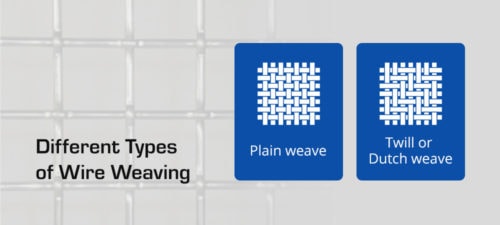
    Different Types of Wire Weaving

    If you select woven wire fabric, many types of weaves are available. Each style varies by mesh count, wire diameter specifications and the number of openings.

    Here are two of the most common types of wire mesh patterns:

    • Plain weave: The plain weave is the most common type. It consists of same-sized diameter wires in a simple over-and-under pattern. The identical design creates the same amount of mesh openings in all directions.
    • Twill or Dutch weave: A twill weave is slightly more complicated than a plain weave, with each wire passing over and under two wires. This structure makes the twill weave more durable and available for larger diameters.

    Types of Woven Wire Crimp Styles

    Woven wire often uses a method known as crimping either before or during creation. If the mesh’s diameter is too big or too small, specialists crimp the wires before weaving. They send the wires through a crimper, and it individually shapes them so they can rest securely against one another. Crimped wire mesh makes the wire fabric stronger and more rigid.

    Here are a few of the crimp styles available for wires:

    • Lock crimp: The lock crimp is a more modern style. It consists of straight sections of wires, where each wire is crimped at each intersection. Lock crimp wire mesh creates an aesthetically pleasing pattern and is also very stable.
    • Double intermediate crimp: A double intermediate crimp forms a square-like pattern with wires of equal size. They pass over and under one another at adjacent intersections with equal lengths.
    • Intercrimp: An intercrimp style uses intersecting wires at every other intersection. For example, wires might intersect at the third intersection, the fifth intersection and so on. This style provides high rigidity and is popular in architecture.
    • Flat top: A flat top crimping style is similar to a lock crimp wire cloth, but all crimps are offset to one side. This design creates a flat appearance on the front, making it ideal for materials to flow smoothly across it. It’s also commonly used in architecture.

    How to Match Weave and Crimp Style

    By matching your crimp and mesh weaving style, you can create an optimized woven wire cloth. The right combination of weaving and crimping styles can make your wire mesh more sturdy or flexible. But with all the crimping options and wire cloth terms, it’s sometimes tricky to know which style fits you best.

    Here are three considerations for picking your weave and crimp styles:

    1. Wire Diameter

    The wire diameter is the width of each wire. The diameter directly effects how much open space exists between wires.

    You can choose diameter according to what conditions your wire will face. For instance, if your wire will mostly encounter small amounts of sand, you wouldn’t need an extremely thick diameter. Usually, the thicker and stronger your wire is, the more you avoid future fixes and replacements.

    2. Mesh Count

    Your wire’s mesh count is the number of openings within an inch. So, if you have a 300 mesh wire, there are 300 openings within one inch in any direction of the wire. When selecting mesh count, consider how many materials will pass through your wire and how many of those you want to block.

    If you choose the wrong mesh count, unwanted materials or substances might reach underneath surfaces. Or, too many substances might build up on your mesh because they can’t pass through.

    3. Micron Rating

    A micron rating is a precise distance between your wires. Once you determine your diameter and mesh count, you can decide upon the best micron rating for your wire’s purposes. People often use micron ratings for wire mesh meant for filtration. The correct micron measurement allows for proper filtration while maintaining a consistent substance flow.

    Order Woven Wire Cloth to Your Specifications

    Whether you need wire mesh for filtering materials or handling sensitive liquids, Argus Steel is here for you. A leader in the metals industry, Argus Steel has provided premier materials since 1979. Our specialty wire cloths are available in many different materials and meet any requirement. We offer durable and high-quality wire cloth, no matter what use you have in mind.

    Request a quote from Argus Steel today to get started with a leading steel wire distributor. No job is too big or too small for us, and we look forward to finding you the best wire cloth fit.