

How Custom Perforated Metal Panels Elevate Architectural Design
Custom perforated metal panels provide precise control over light transmission, airflow, acoustic properties and privacy screening while creating patterns and textures that define a building’s character. This guide explores the specific visual and functional improvements these panels deliver for contemporary projects.
Aesthetic Benefits of Perforated Metal Panels
Decorative perforated metal panels enhance the visual impact of architectural facades and interior installations.
Creates Visual Interest
Perforations add depth to metal sheets through shadow patterns that change as light hits the surface at different angles throughout the day. This makes perforated metal design practical for architects looking to avoid blank wall expanses on commercial and industrial buildings.
Common perforation patterns include:
- Straight rows: Holes aligned in uniform rows and columns for a clean appearance
- Staggered rows: Offset hole placement that creates diagonal visual movement
- Hexagonal arrays: Six-sided hole arrangements that maximize open area
- Custom geometric forms: Radiating patterns, gradient densities or organic shapes
Installing the panels with an air gap between the metal and the wall increases the depth effect as light plays across multiple layers. You can also bend perforated metal into wave-like patterns and add depth to the installation.
Adds a Textured Appearance
The holes in perforated metal panels create texture by mixing solid metal with empty space. You see this most clearly on polished stainless steel or brushed aluminum. The texture looks different depending on how far away you are and what angle you’re looking from. For interior spaces like lobbies and atriums, you can backlight the panels to highlight the pattern.
Allows for Custom Patterns
Custom perforation services let you specify hole size, shape, spacing and arrangement. You can incorporate varying hole densities, radiating layouts or geometric forms that distinguish your building from standard commercial construction. Perforating can also show images on metal panels by varying hole size and spacing. This works for company logos or graphics that double as signage.
Enhances Materiality and Light Interaction
Each metal performs differently when perforated:
- Aluminum is lightweight and resists corrosion, which makes it good for exterior work.
- Stainless steel holds up in harsh conditions and stays looking good longer.
- Copper and brass age into patinas that change how cladding looks over time.
How much light gets through depends on the percentage of open area. At around 30% open area, you can get good light transmission but keep visual screening. At around 60% open area, the panels can look almost transparent from some angles but still carry structural loads. The finish matters too. Matte surfaces spread light out softly, while polished panels create hard edges between the solid areas and the holes.
Functional Benefits of Perforated Metal Panels
Perforated metal panels solve many practical problems in building design.
Maintains Structural Integrity
Engineers can calculate the strength of perforated panels based on the hole pattern and the open area percentage. Many perforated sheets maintain sufficient strength for cladding and screening applications without requiring structural support beyond standard mounting systems. The perforation process uses precision punching or laser cutting to keep clean edges. This matters because poor perforation can create weak points.
Offers Material Flexibility and Durability
Perforating works with carbon steel, stainless steel, galvanized steel, aluminum, copper and brass. The material you pick depends on the environment, how strong it needs to be, how much it can weigh and what you want it to look like. For instance, stainless steel grades 304 and 316 are often chosen in coastal areas or industrial sites where corrosion is a problem.
You can also get different finishes, such as mill finish, brushed, polished, powder-coated or anodized aluminum. The finish protects the metal and gives you options to match your project specifications.
Optimizes Airflow
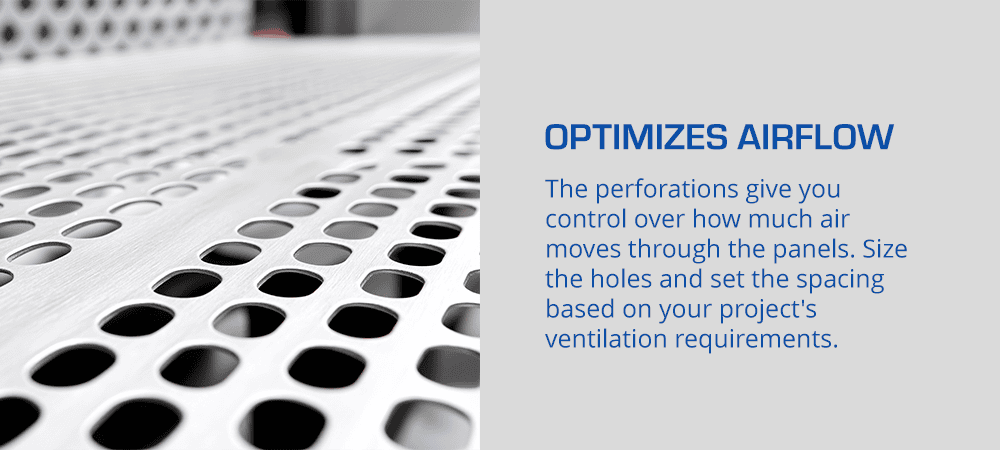
The perforations give you control over how much air moves through the panels. Size the holes and set the spacing based on your project’s ventilation requirements. For example, if you are designing a garage, you need to specify a perforation pattern that moves enough air to meet exhaust-removal regulations but keeps the holes small enough to block rain.
Improves Acoustic Performance
Perforated metal backed with insulation absorbs sound and reduces echo in large spaces. Sound waves travel through the holes and get trapped in the insulation behind the panel. Therefore, these panels work well in:
- Manufacturing plants: Control equipment noise while using metal surfaces that hold up to industrial conditions and clean easily.
- Office environments: Lower ambient noise and make it easier to hear conversations without losing the strength and low upkeep of metal ceiling systems.
- Public areas: Manage noise in restaurants, stores and building lobbies where you want the look of exposed metal but need acoustic control.
Provides Precise Light Control and Shading
Perforated panels can act as sunshades. They block direct sunlight but let in diffused light, so you need less artificial lighting during the day. How much solar heat the panels reject depends on the perforation percentage and the angle at which you mount them.
South and west-facing walls take the most sun, especially in the afternoon. Perforated sunshades on these exposures block the low-angle light while keeping views open and letting natural light in. You can mount them in fixed positions or build them into louver systems that move with the sun.
Delivers Both Privacy and Security
Perforated panels screen views and still let air and light through. The amount of screening you get depends on the viewing angle, the density of the holes and how far away someone is from the panel. Custom metal screens with a lower open area can provide privacy at ground level while appearing more transparent when you’re inside looking out.
Security applications include guards for equipment, window protection and perimeter fencing. The privacy screens let you see through them for monitoring but stop unauthorized access. They stay strong even with material removed by the perforations, so you get physical security that looks better than solid barriers or chain links.
Contributes to Sustainability
Perforated metal panels that serve as sunshades cut cooling loads and the need for artificial lighting during daytime hours, lowering both HVAC energy use and peak power demand.
Moreover, the materials themselves support sustainable construction practices. For instance, aluminum used in perforated panels is infinitely recyclable. Recycled aluminum requires only 5% of the energy needed to produce new aluminum and cuts greenhouse gas emissions by approximately 95%. Steel similarly recycles repeatedly without degrading, with millions of metric tons of steel recycled per year.
Metal’s durability also means longer service life compared to many alternative materials, which reduces the frequency of replacement and the associated environmental impact of manufacturing and shipping panels.
Get Perforated Metal Panels From Argus Steel
Argus Steel perforates stainless steel, galvanized steel, aluminum, brass, copper and titanium in gauges from 28 up to plate thicknesses. We handle round, square, slotted and hexagonal hole patterns in both stock and custom configurations.
Beyond perforation, we provide shearing, forming, bending, polishing, powder coating and other finishing services to deliver panels ready for installation. Our stock availability and quick-ship program mean faster turnaround on standard specifications.
Explore our extensive stock list or request a quote now to kick-start your project.
Comments are closed